
The importance of early testing for BCR::ABL1 mutations in CML
What are BCR::ABL1 mutations?
BCR::ABL1 kinase domain mutations in CP-CML and Ph+ ALL are acquired alterations that may decrease TKI sensitivity and are evaluated in cases of inadequate response or treatment failure to help inform treatment decisions.
Resistance may be due to mutations within the BCR::ABL1 domain1,2
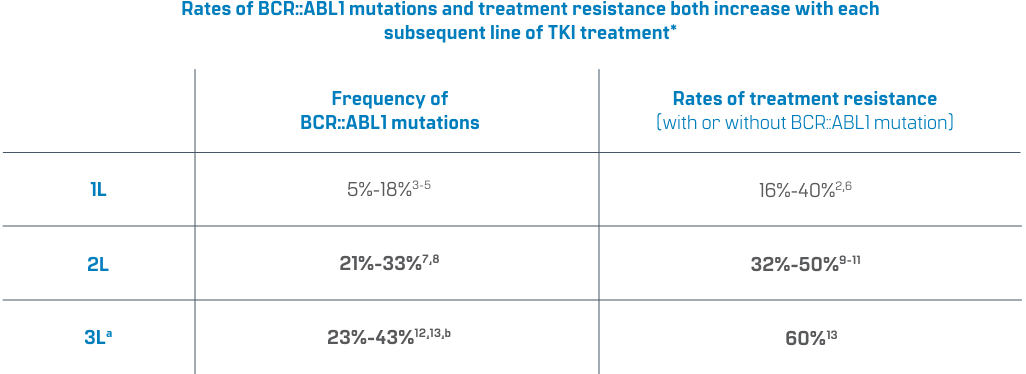
- BCR::ABL1 point mutations are a common cause of secondary resistance to TKI therapy and are associated with poor prognosis and a higher risk of disease progression14
- T315I is the most problematic BCR::ABL1 mutation and confers in vitro resistance to all 1st- and 2nd-generation TKIs15
aResults are primarily from a 3L study with 2G TKI therapy but also included 3 patients taking 4L 2G TKI therapy.
bApproximately two-thirds of patients have not yet mutated.
*Based on nonrandomized, observational, retrospective studies that may have unobserved confounding and treatment selection biases as well as other limitations that should be considered when comparing results with clinical trials. Outcomes should be interpreted with caution due to small sample size.
1L=first line, 2G=second generation, 2L=second line, 3L=third line, 4L=fourth line, BCR::ABL1=Breakpoint Cluster Region/Abelson Murine Leukemia viral oncogene homolog, TKI=tyrosine kinase inhibitor.
bApproximately two-thirds of patients have not yet mutated.
*Based on nonrandomized, observational, retrospective studies that may have unobserved confounding and treatment selection biases as well as other limitations that should be considered when comparing results with clinical trials. Outcomes should be interpreted with caution due to small sample size.
1L=first line, 2G=second generation, 2L=second line, 3L=third line, 4L=fourth line, BCR::ABL1=Breakpoint Cluster Region/Abelson Murine Leukemia viral oncogene homolog, TKI=tyrosine kinase inhibitor.
There is an inherent need for consistent monitoring of patients with CP-CML16,c:
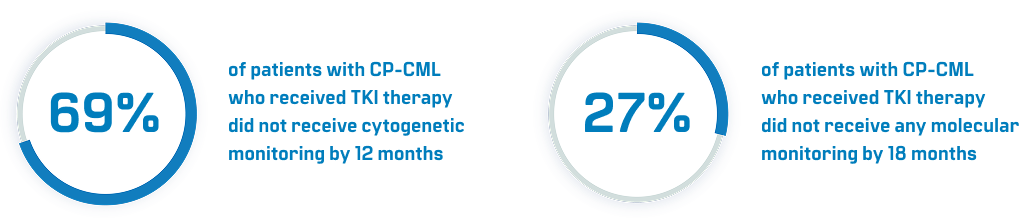
cFindings from a retrospective study of 410 patients with CP-CML initiating TKI therapy between January 2008 and December 2010.16
CP-CML=chronic-phase chronic myeloid leukemia, TKI=tyrosine kinase inhibitor.
CP-CML=chronic-phase chronic myeloid leukemia, TKI=tyrosine kinase inhibitor.
PCR monitoring is associated with a lower risk of progression or mortality17
Survival probability for mortality or progression to accelerated phase or blast phase chronic myeloid leukemia in all patients, stratified by number of PCR tests17
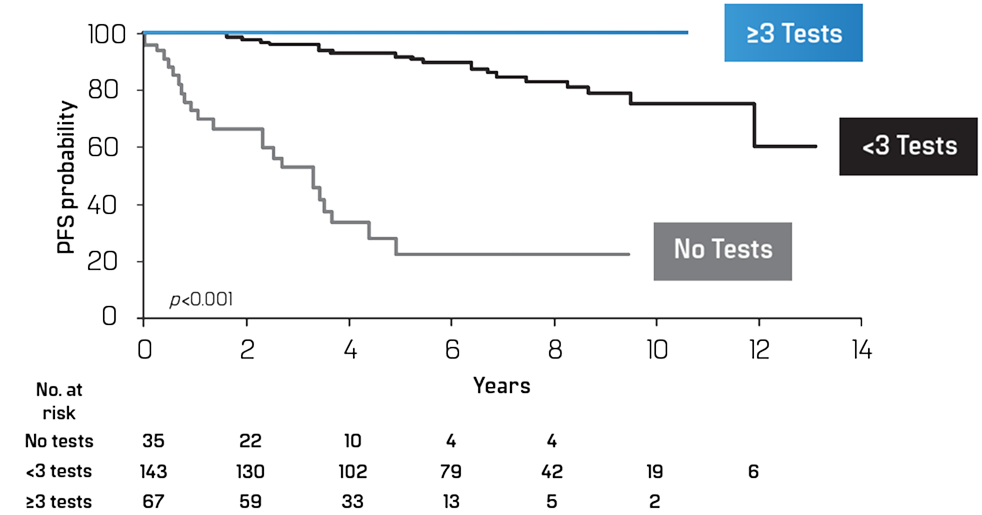
PCR=polymerase chain reaction; PFS=progression-free survival; TKI=tyrosine kinase inhibitor.
NCCN Guideline recommendations on mutation testing in CML
Monitoring early treatment response milestones for resistance14
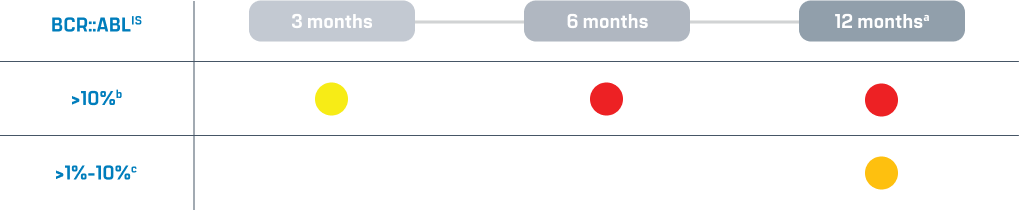
Monitoring Response to TKI Therapy14
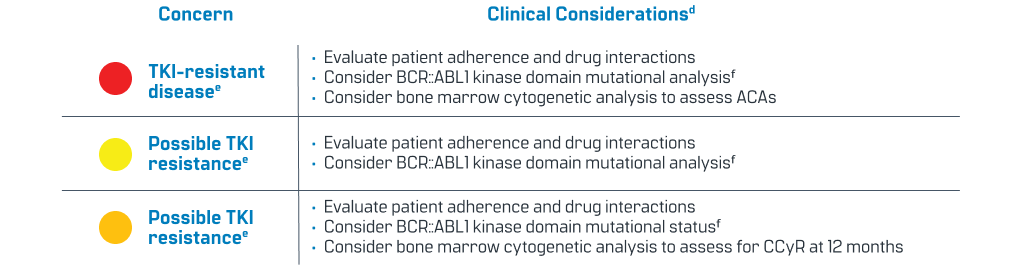
aBCR::ABL1IS ≤0.1% at 12 months is associated with a very low probability of subsequent loss of response and a high likelihood of achieving a subsequent deep molecular response (DMR MR4.0; BCR::ABL1IS ≤0.01%), which is a prerequisite for a trial of treatment-free remission (TFR).
bAchievement of response milestones must be interpreted within the clinical context. Patients with BCR::ABL1 only slightly >10% at 3 months and/or with a steep decline from baseline may achieve <10% at 6 months and have generally favorable outcomes. Therefore, it is important to interpret the value at 3 months in this context before making drastic changes to the treatment strategy. Same dose of TKI can be continued for another 3 months but imatinib is associated with slower molecular responses.
cAchievement of response milestones must be interpreted within the clinical context. Patients achieving MCyR (BCR::ABL1IS ≤10%) at 12 months have good long-term survival. Patients with more than 50% reduction compared to baseline or minimally above the 10% cutoff can continue the same dose of TKI for another 3 months. Consider switching to alternate 2G TKI or 3G TKI or allosteric TKI in the absence of continuing decline in BCR::ABL1 transcript levels.
dSwitching to an alternate TKI for intolerance is appropriate for patients with disease responding to TKI therapy.
eConsider referral to a specialized CML center and/or enrollment in a clinical trial.
fConsider myeloid mutation panel to identify BCR::ABL1-independent resistance mutations in patients with no BCR::ABL1 kinase domain mutations.
bAchievement of response milestones must be interpreted within the clinical context. Patients with BCR::ABL1 only slightly >10% at 3 months and/or with a steep decline from baseline may achieve <10% at 6 months and have generally favorable outcomes. Therefore, it is important to interpret the value at 3 months in this context before making drastic changes to the treatment strategy. Same dose of TKI can be continued for another 3 months but imatinib is associated with slower molecular responses.
cAchievement of response milestones must be interpreted within the clinical context. Patients achieving MCyR (BCR::ABL1IS ≤10%) at 12 months have good long-term survival. Patients with more than 50% reduction compared to baseline or minimally above the 10% cutoff can continue the same dose of TKI for another 3 months. Consider switching to alternate 2G TKI or 3G TKI or allosteric TKI in the absence of continuing decline in BCR::ABL1 transcript levels.
dSwitching to an alternate TKI for intolerance is appropriate for patients with disease responding to TKI therapy.
eConsider referral to a specialized CML center and/or enrollment in a clinical trial.
fConsider myeloid mutation panel to identify BCR::ABL1-independent resistance mutations in patients with no BCR::ABL1 kinase domain mutations.
NCCN Guidelines®: Types of tests and when to use each
Mutational analysis should be considered when patients experience any of the following14,18:
Failure to achieve response milestones

Progression to a more advanced phase

Display any sign of loss of response (hematologic or cytogenetic relapse)

Bone marrow cytogeneticsg

- At diagnosis
- Response milestones not reached
- Any sign of loss of hematologic response
- Any sign of loss of CCyR or its molecular response correlate (MR 2.0: BCR::ABL1IS ≤1%)—defined as an increase in BCR::ABL1 transcript to >1%
qPCR using IS

- At diagnosis
- Every 3 months after initiating treatment. After BCR::ABL1IS ≤1% (MR 2.0)h has been achieved, every 3 months for 2 years and every 3-6 months thereafter
- If there is a 1-log increase in BCR::ABL1 transcript levels with MMR, qPCR should be repeated in 1-3 months
BCR::ABL1 kinase domain mutation analysisi

- Chronic phase
- Response milestones not reached
- Any sign of loss of hematologic response
- Any sign of loss of CCyR or its molecular response correlate (MR 2.0: BCR::ABL1IS ≤1%)— defined as an increase in BCR::ABL1 transcript to >1%
- 1-log increase in BCR::ABL1 transcript levels and loss of MMR
- Response milestones not reached
- Disease progression to accelerated or blast phasei
gFISH has been inadequately studied for monitoring response to treatment.
hCCyR correlates with BCR::ABL1IS ≤1% (MR2.0).
iConsider myeloid mutation panel to identify BCR::ABL1-independent resistance mutations in patients with no BCR::ABL1 kinase domain mutations.
2G=second generation; 3G=third generation, ACA=additional chromosomal abnormalities; BCR:ABL1=breakpoint cluster region-ABL proto-oncogene 1; CCyR=complete cytogenetic response; CML=chronic myeloid leukemia; FISH=fluorescence in situ hybridization; MCyR=major cytogenetic response; MMR=major molecular response; NCCN=National Comprehensive Cancer Network; qPCR=quantitative polymerase chain reaction; TKI=tyrosine kinase inhibitor.
hCCyR correlates with BCR::ABL1IS ≤1% (MR2.0).
iConsider myeloid mutation panel to identify BCR::ABL1-independent resistance mutations in patients with no BCR::ABL1 kinase domain mutations.
2G=second generation; 3G=third generation, ACA=additional chromosomal abnormalities; BCR:ABL1=breakpoint cluster region-ABL proto-oncogene 1; CCyR=complete cytogenetic response; CML=chronic myeloid leukemia; FISH=fluorescence in situ hybridization; MCyR=major cytogenetic response; MMR=major molecular response; NCCN=National Comprehensive Cancer Network; qPCR=quantitative polymerase chain reaction; TKI=tyrosine kinase inhibitor.
Kinase domain testing results and TKI sensitivity19
IC50 (nM) of ATP-competitive BCR::ABL1 TKIs against single mutantsa
(corrected for protein binding and drug bioavailability)
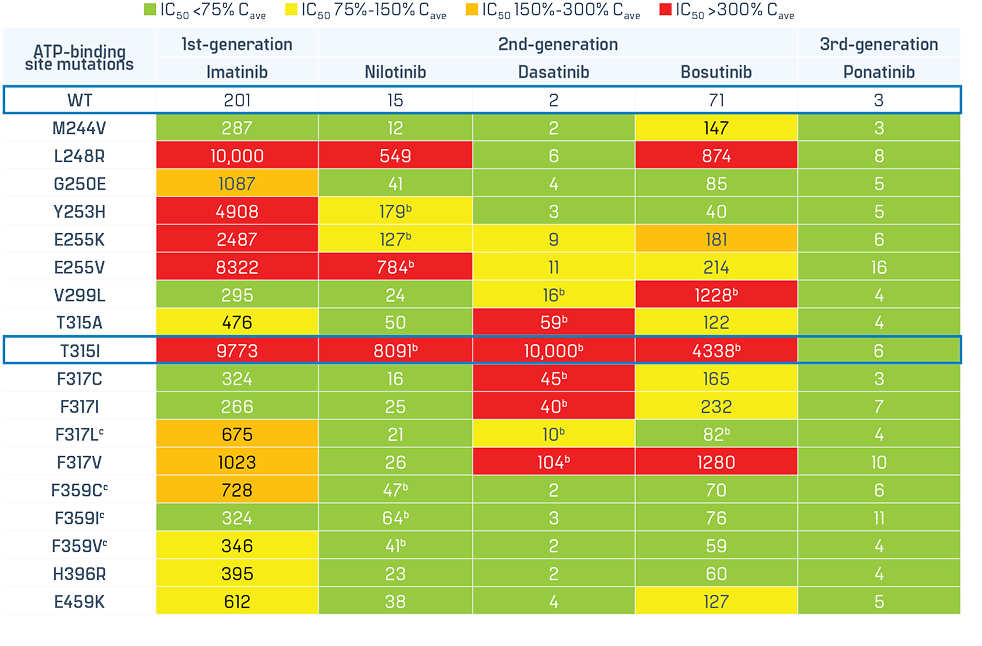
aMean IC50 from 3 separate experiments in engineered Ba/F3 cells (corrected for protein binding and drug availability in the serum).19
bMutations conferring clinical resistance to 2nd-generation BCR::ABL1 TKIs: T315I, V299L, G250E, and F317L for bosutinib; T315I/A, F317L/V/I/C, and V299L for dasatinib; and T315I, Y253H, E255K/V, and F359V/C/I for nilotinib.20
Asciminib (non-ATP competitive TKI)
cNCCN Guidelines state that A337T, P465S, M244V, F359V/I/C, b2(e13)a3, and b3(e14)a3 are contraindicated mutations/variants for asciminib.6
Preclinical data do not translate into clinical efficacy. The clinical effect of these data is not known as they are from in vitro studies. Clinical efficacy can only be proven through randomized controlled trials.
bMutations conferring clinical resistance to 2nd-generation BCR::ABL1 TKIs: T315I, V299L, G250E, and F317L for bosutinib; T315I/A, F317L/V/I/C, and V299L for dasatinib; and T315I, Y253H, E255K/V, and F359V/C/I for nilotinib.20
Asciminib (non-ATP competitive TKI)
cNCCN Guidelines state that A337T, P465S, M244V, F359V/I/C, b2(e13)a3, and b3(e14)a3 are contraindicated mutations/variants for asciminib.6
Preclinical data do not translate into clinical efficacy. The clinical effect of these data is not known as they are from in vitro studies. Clinical efficacy can only be proven through randomized controlled trials.
ATP=adenosine triphosphate; Cₐᵥₑ=average plasma concentration; IC₅₀=half maximal inhibitory concentration; NCCN=National Comprehensive Cancer Network; TKI=tyrosine kinase inhibitor; WT=wild type.