
TKI resistance is a critical event in the treatment of Chronic Phase-Chronic Myeloid Leukemia1

CCyR rates with back-to-back 2G TKIs are low, particularly for patients with resistance to their last prior therapy1,2
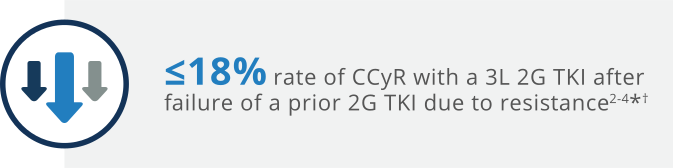
≤18% rate of CCyR with a 3L 2G TKI after failure of a prior 2G TKI due to resistance.
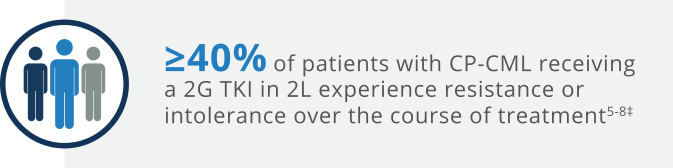
≤40% of patients with CP-CML receiving a 2G TKI in 2L experience resistance or intolerance over the course of treatment.

*Data are from the Ibrahim et al [N=26], Garg et al [N=48], and Garcia-Gutierrez et al [N=105] publications. Ibrahim et al analyzed a cohort of patients with CP-CML who failed dasatinib (n=20) or nilotinib (n=6) after imatinib in various phase 2 studies; none of the 7 patients with prior hematologic resistance to TKI therapy achieved CCyR. Garg et al analyzed CML patients (AP, BP, and CP) sequentially treated with 3 different TKIs at MD Anderson Cancer Center; 34 received dasatinib after imatinib and nilotinib failure, and 14 received nilotinib after imatinib and dasatinib failure. Among 25 patients with CP-CML receiving 3L therapy, only 2 of 17 who had failed 2L due to resistance achieved CCyR in 3L. Garcia-Gutierrez et al identified 105 patients treated with a 2G TKI in 2L after imatinib failure in a Spanish national registry; 17 of 31 patients who started 3L therapy with another TKI did so due to resistance, and the cumulative incidence of CCyR among these patients was 18%.2-4

Based on nonrandomized, observational, retrospective studies that may have unobserved confounding and treatment selection biases as well as other limitations that should be considered when comparing results with clinical trials. Outcomes should be interpreted with caution due to small sample size.  

Data are from clinical trials of 2L bosutinib [N=46; N=288], nilotinib [N=321], and dasatinib [N=150] in patients with CP-CML who were resistant or intolerant to prior TKI therapy.

2G=second generation; 2L=second line; 3L=third line; AP=accelerated phase; BP=blast phase; CCyR=complete cytogenetic response; CHR=complete hematologic response; CML=chronic myeloid leukemia; CP=chronic phase; CP-CML=chronic-phase chronic myeloid leukemia; TKI=tyrosine kinase inhibitor.

Resistance may be due to mutations within the BCR::ABL1 domain9,10

Rates of BCR::ABL1 mutations and treatment resistance both increase with each subsequent line of TKI treatment*
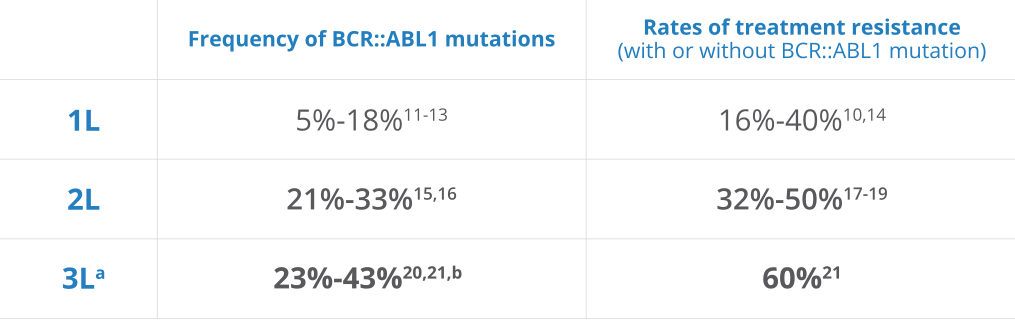
Table showing that the frequency of BCR::ABL1 mutations and treatment resistance increase with each subsequent line of TKI treatment, from 1L to 3L.

Early identification of resistant mutations is crucial to informing your patient’s next line of treatment22

aResults are primarily from a 3L study with 2G TKI therapy, but also included 3 patients taking 4L 2G TKI therapy.
bApproximately two-thirds of patients have not yet mutated.

*Based on nonrandomized, observational, retrospective studies that may have unobserved confounding and treatment selection biases as well as other limitations that should be considered when comparing results with clinical trials. Outcomes should be interpreted with caution due to small sample size.

2G=second generation; 2L=second line; 3L=third line; AP=accelerated phase; BP=blast phase; CCyR=complete cytogenetic response; CHR=complete hematologic response; CML=chronic myeloid leukemia; CP=chronic phase; CP-CML=chronic-phase chronic myeloid leukemia; TKI=tyrosine kinase inhibitor.

For patients heavily pretreated with TKIs, consider ICLUSIG

For patients with CML, regardless of mutations, consider ICLUSIG

ICLUSIG is a third-generation pan-mutational TKI

2G=second generation; 2L=second line; 3L=third line; AP=accelerated phase; BP=blast phase; CCyR=complete cytogenetic response; CHR=complete hematologic response; CML=chronic myeloid leukemia; CP=chronic phase; CP-CML=chronic-phase chronic myeloid leukemia; TKI=tyrosine kinase inhibitor.